LkProver
Generates LaTeX derivation trees for LK sequents
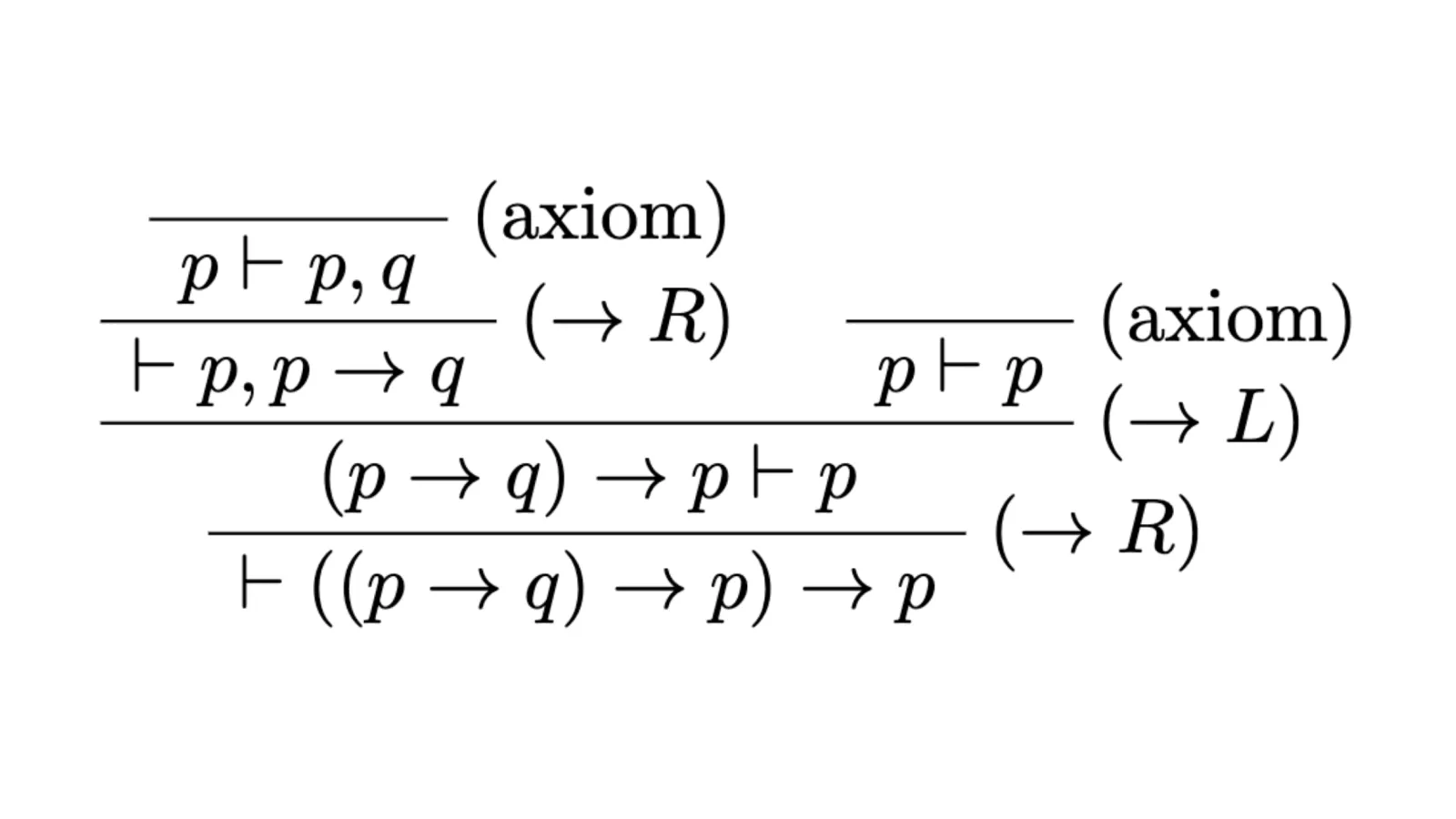
LkProver constructs derivation trees for LK sequents and converts them into corresponding LaTeX snippets.
Contents
Usage
Dune is required to run this tool.
dune exec bin/main.exe '|- ((p -> q) -> p) -> p'The above command will output the following LaTeX snippet:
\begin{prooftree}
\AxiomC{}
\RightLabel{(axiom)}
\UnaryInfC{$p \vdash p, q$}
\RightLabel{($\rightarrow R$)}
\UnaryInfC{$\vdash p, p \rightarrow q$}
\AxiomC{}
\RightLabel{(axiom)}
\UnaryInfC{$p \vdash p$}
\RightLabel{($\rightarrow L$)}
\BinaryInfC{$(p \rightarrow q) \rightarrow p \vdash p$}
\RightLabel{($\rightarrow R$)}
\UnaryInfC{$\vdash ((p \rightarrow q) \rightarrow p) \rightarrow p$}
\end{prooftree}
Input format
Here is the input syntax of LkProver. The precedence of connectives follows the usual one.
<sequent> ::= <expr> "⊢" <expr>
            | <expr> "|-" <expr>
            | <expr> "⇒" <expr>
            | <expr> "=>" <expr>
<expr>    ::= <var>
            | "⊥" | "_|_"
            | "¬" <expr> | "~" <expr> | "!" <expr>
            | <expr> "∧" <expr> | <expr> "/\" <expr> | <expr> "^" <expr> | <expr> "&" <expr>
            | <expr> "∨" <expr> | <expr> "\/" <expr> | <expr> "|" <expr>
            | <expr> "→" <expr> | <expr> "->" <expr>
            | "(" <expr> ")"
<var>     ::= [A-Za-z][A-Za-z0-9_]*
Output format
Currently, the output LaTeX snippet assumes that the bussproofs package is used.
I will consider supporting other packages including proof.sty in the future.
Inference Rules
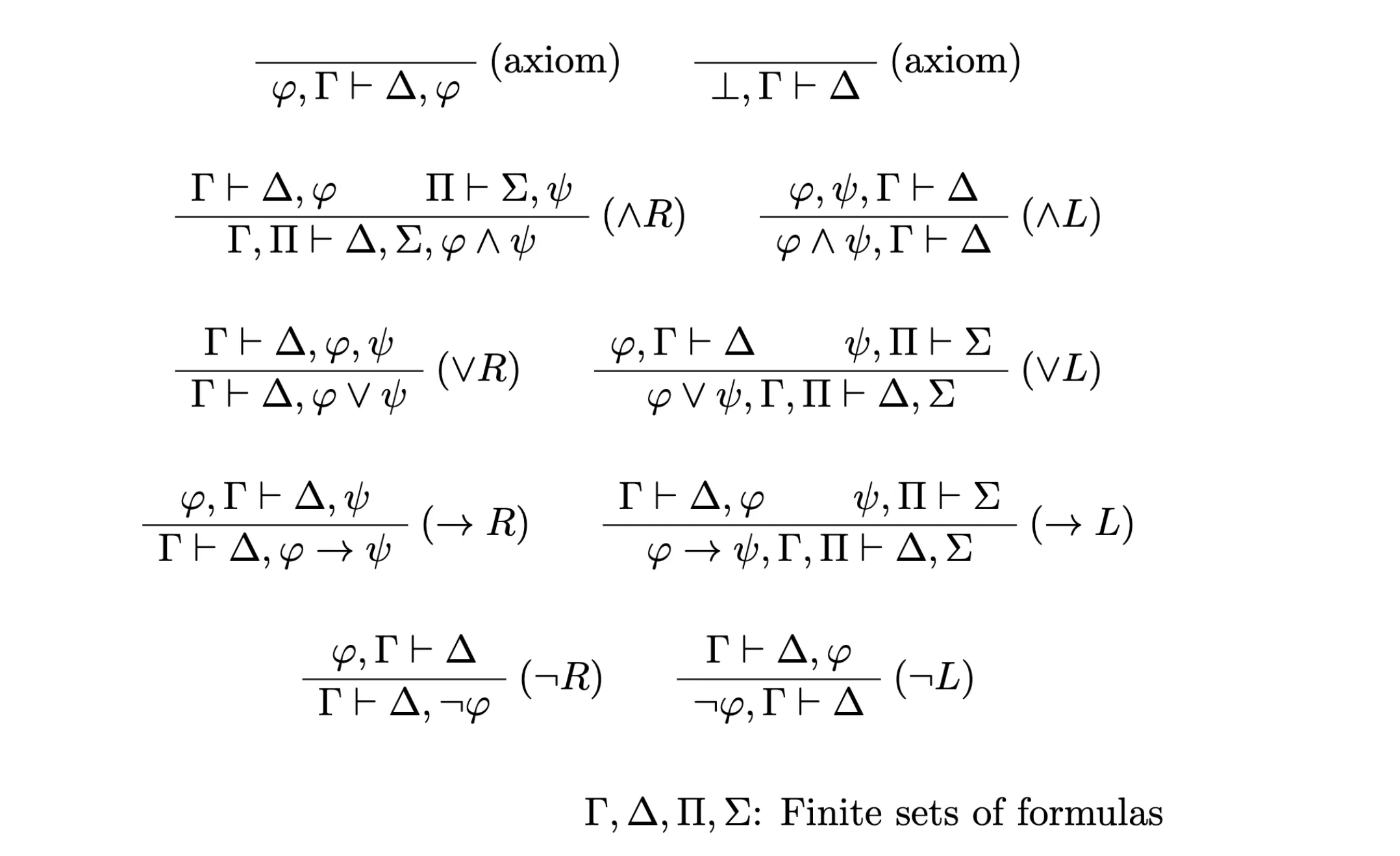
LkProver adopts the following inference rules (what I learned in a logic lecture):
Implementation highlights
LkProver is implemented in OCaml. The implementation is very straightforward, just following the inference rules above.
I used Menhir and sedlex for parsing and lexing input sequents.
My experience with sedlex was great because lexer specifications are embedded in regular OCaml source files, so we can benefit from OCaml Language Server, unlike Menhir which is written in separate .mly files.
If you are interested, please check out the repository.